

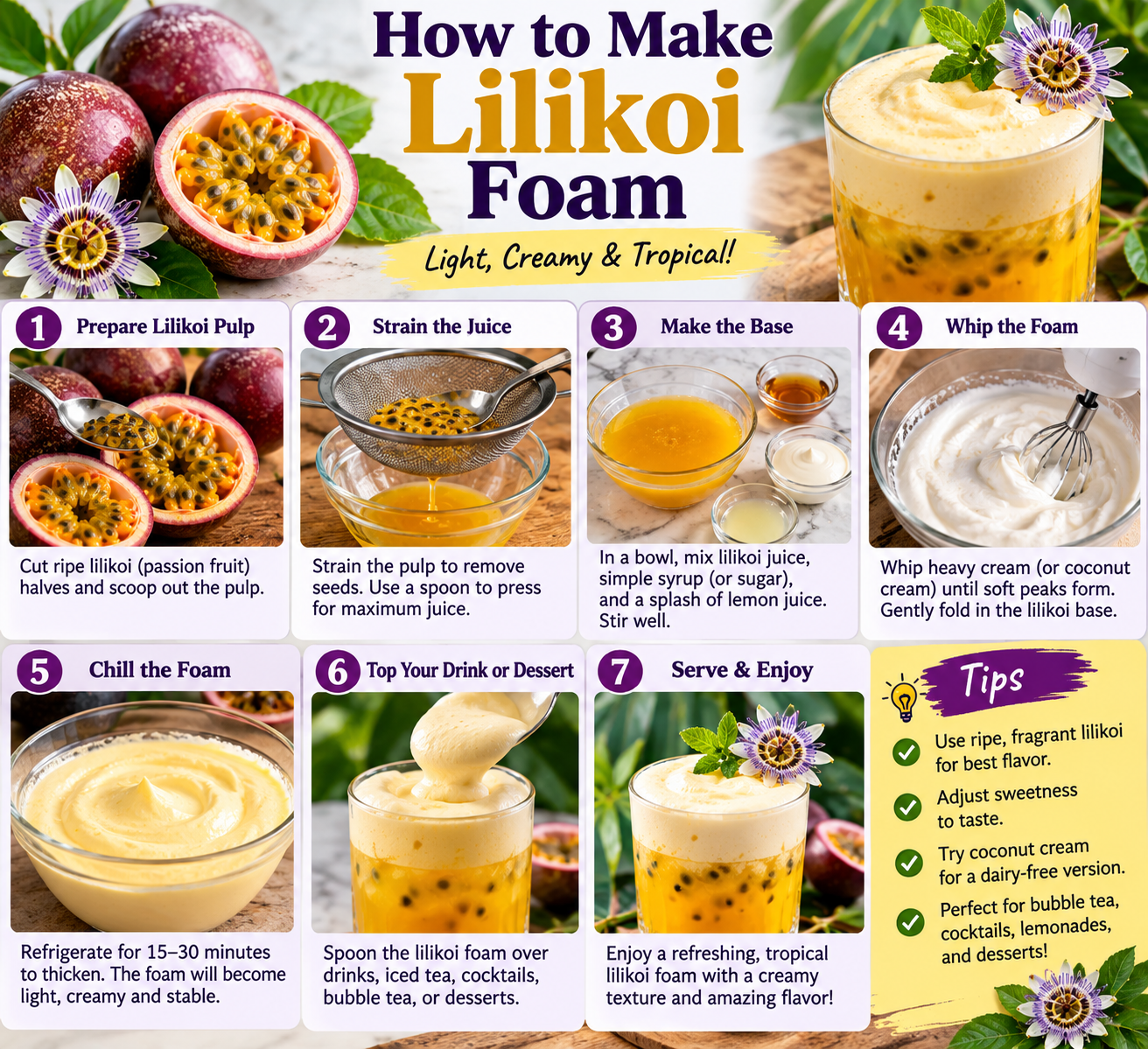
To cultivate passion fruit from scratch and use it in elite culinary applications, you need two distinct skill sets: propagation and culinary extraction. Learning how to grow lilikoi from seed requires seed scarification and stable soil temperatures around 21°C to 29°C (70°F to 85°F), while mastering how to make lilikoi foam relies on balancing fresh passion fruit juice with gelatin or egg whites inside a whipped cream dispenser to achieve stable, aromatic aeration.
Whether you are cultivating the vine for fresh harvest or figuring out how to make lilikoi jam for artisanal branding and culinary prep, this guide breaks down the precise botanical and culinary frameworks you need. No fluff—just exact steps.
The Lilikoi Profile Matrix
Lilikoi (Passiflora edulis) carries a high-acid, highly aromatic profile that appeals to both home gardeners and premium beverage or culinary brands. Below is a breakdown of how the plant’s various uses translate into sensory profiles and application fits.
- Lilikoi Seed Propagation | Earthy, patient, high-yield botanical process | Best for home growers, tropical permaculture, and orchard starters.
- Lilikoi Cocktail Foam | Velvety, tart, highly aromatic top layer | Best for craft mixology, cocktail bars, and tropical dessert toppings.
- Lilikoi Artisanal Jam | Sweet-tart, rich, textured preserves | Best for specialty food brands, pastry filling, and breakfast spreads.
- Lilikoi Puree & Syrup | Concentrated, bright, versatile acid base | Best for beverage foundations, marinades, and dressing bases.
Botanical & Culinary Chemistry Breakdown
Understanding the chemistry behind lilikoi ensures success whether you are in the garden or the kitchen.
Seed Germination Dynamics
Lilikoi seeds possess a tough outer coat (testa) surrounded by an aril. The aril contains natural germination inhibitors. Scarifying the seed coat by gently rubbing it against mild sandpaper or soaking it in warm water or milk for 24 hours breaks down these chemical inhibitors. Soil temperature must remain consistently warm; cooler soil drastically reduces germination rates and encourages seed rot.
Foam Aeration Mechanics
Creating a stable foam with lilikoi juice requires overcoming high acidity. Passion fruit juice typically sits at a low pH ($pH \approx 2.8 – 3.2$), which can break down un-stabilized egg whites or dairy quickly. Incorporating a stabilizing agent—such as gelatin, soy lecithin, or gelatin mixed with heavy cream—enables the liquid to hold trapped nitrous oxide ($N_2O$) gas bubbles without collapsing immediately upon exposure to air.
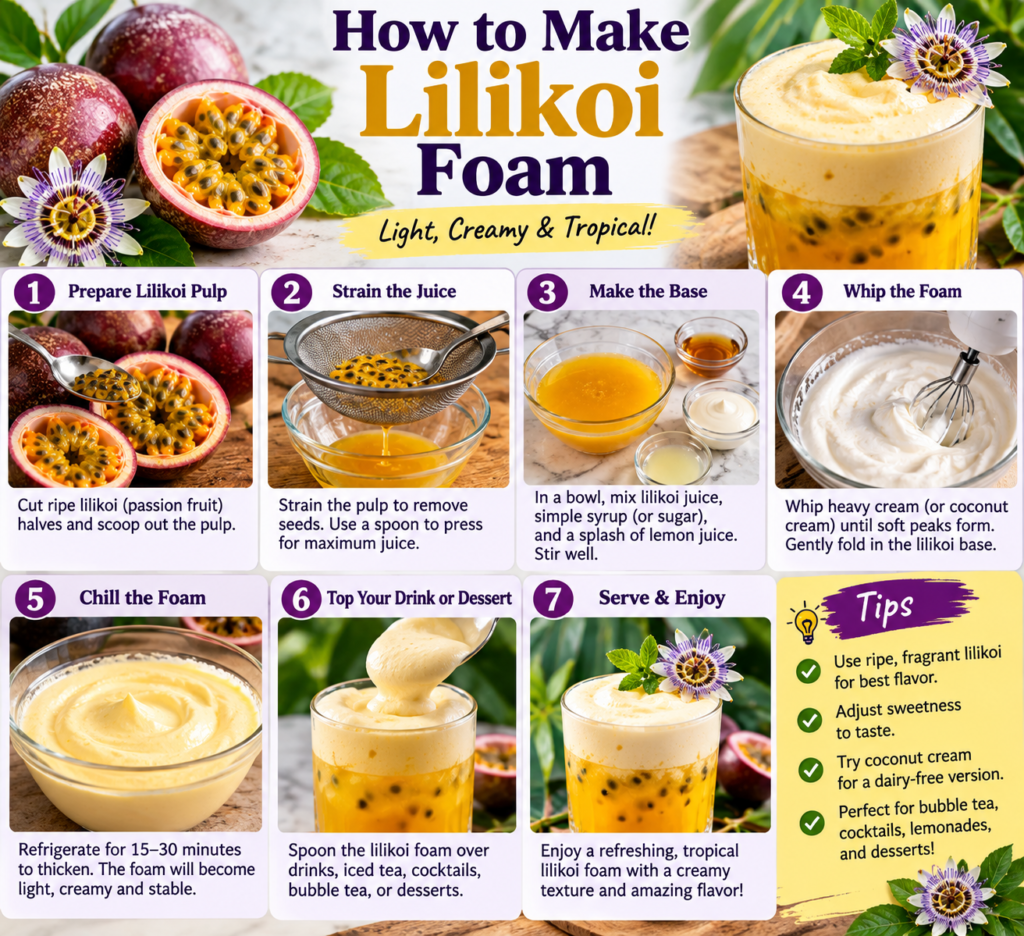
Lilikoi Usage & Extraction Matrix
| Process | Key Ingredient / Variable | Target Texture / Result | Optimal Application |
| Seed Growing | Warm moisture, scarified seed | Strong taproot & vine germination | Backyard trellis, orchard cultivation |
| Foam Preparation | Lilikoi juice, gelatin, $N_2O$ charger | Dense, velvety micro-foam | Cold brew top, Mai Tai, tropical cocktails |
| Jam Making | Equal parts pulp/sugar, natural pectin | Glossy, spreadable setting | Artisanal jarred goods, pastry glazes |
| Puree Strain | Fresh fruit pulp, fine mesh strainer | Smooth, seedless aromatic liquid | Syrups, gelatos, cocktail bases |
Step-by-Step Instructions
How to Grow Lilikoi From Seed
- Extract and Clean Seeds: Scoop pulp from ripe, slightly wrinkled lilikoi fruits. Wash the seeds thoroughly in a fine-mesh sieve under cool water to remove all traces of the gelatinous aril.
- Scarify and Soak: Gently rub dried seeds between sheets of fine-grit sandpaper to wear down the hard outer casing. Soak seeds in warm water for 24 to 48 hours.
- Plant in Seed-Starting Mix: Sow seeds $0.5\text{ cm}$ deep in sterile, well-draining seed-starting mix. Keep the soil constantly moist but not waterlogged.
- Maintain Heat and Light: Place the tray on a heating mat set between 21°C and 29°C (70°F to 85°F) under bright, indirect light. Germination typically occurs within 2 to 6 weeks.
- Transplant: Once seedlings develop two sets of true leaves, pot them into larger containers or plant them along a sturdy trellis system in full sun.
How to Make Lilikoi Foam
- Prepare the Base: Mix $100\text{ ml}$ of fresh strained lilikoi juice with $50\text{ ml}$ of simple syrup ($1:1$ ratio) and $100\text{ ml}$ of heavy cream or egg white liquid.
- Bloom Gelatin (Alternative Option): If creating a dairy-free foam, bloom $2\text{ g}$ of powdered gelatin in $20\text{ ml}$ of warm water, then whisk thoroughly into the lilikoi juice and syrup mixture.
- Strain the Mixture: Pour the liquid through a fine-mesh conical strainer directly into a whip siphon (whipped cream dispenser) to remove any solid particles that could clog the nozzle.
- Charge and Chill: Seal the siphon, charge it with one $N_2O$ (nitrous oxide) cartridge, and shake vigorously for 30 seconds. Chill in the refrigerator for at least 1 hour before dispensing over beverages or desserts.
How to Make Lilikoi Jam
- Extract Pulp: Scoop out the pulp and seeds from 15–20 ripe lilikoi fruits. (Optional: Strain half the pulp to remove seeds if a smoother texture is preferred).
- Combine Ingredients: In a heavy-bottomed saucepan, combine $400\text{ g}$ of lilikoi pulp/juice with $400\text{ g}$ of granulated white sugar and $1\text{ tbsp}$ of fresh lemon juice.
- Boil to Gel Point: Heat over medium-high heat, stirring constantly until the sugar dissolves. Bring to a rolling boil and cook until the temperature reaches $104^\circ\text{C}$ ($220^\circ\text{F}$) on a candy thermometer.
- Jar and Seal: Ladle hot jam into sterilized glass jars, leaving $0.5\text{ cm}$ of headspace. Seal tightly and process in a hot water bath for 10 minutes for long-term shelf storage.
Common Pitfalls When Growing & Preparing Lilikoi
- Planting Un-scarified Seeds Directly: Lilikoi seeds have a thick outer casing; skipping the scarification step can delay germination by several months or lead to rotting in wet soil.
- Over-heating Foam Base: Heating lilikoi juice above 60°C (140°F) degrades its delicate tropical aromatic compounds, leaving behind an overly cooked, flat acid profile.
- Incorrect Jam Pectin Ratios: Lilikoi has natural pectin in its membranes, but high juice volumes require precise sugar ratios ($1:1$ weight ratio is standard) to achieve a proper set without adding artificial thickeners.
- Clogged Siphon Nozzles: Failing to pass the lilikoi liquid through a fine-mesh strainer before loading it into a siphon dispenser will block the valve with microscopic seed remnants.
Strategic Selection Framework
Whether choosing the right cultivation setup or perfecting a signature product recipe, use this sequential framework:
- Determine Fruit Sourcing: Decide whether your volume requirements warrant growing vines from seed or sourcing raw frozen pulp.
- Evaluate Thermal Stability: Match your cultivation zone to lilikoi requirements (USDA zones 9–11) or set up greenhouse controls.
- Calibrate Acid vs. Sugar Ratio: Test fresh juice Brix levels before making jam or foam to adjust added sweetener dynamically.
- Validate Storage Metrics: Ensure canned jam hits a $pH < 4.6$ for shelf stability, and siphon foams remain chilled below 4°C (40°F) for service safety.
Frequently Asked Questions
How long does it take to grow lilikoi from seed to fruit?
When growing lilikoi from seed, germination takes 2 to 6 weeks. Under optimal full-sun conditions with proper trellising, vines typically begin flowering and producing fruit within 12 to 18 months from germination.
Can you make stable lilikoi foam without dairy or egg whites?
Yes. You can create a stable vegan foam using bloomed gelatin, agar-agar, or xanthan gum mixed with aquafaba (chickpea fluid). Combine $100\text{ ml}$ of strained lilikoi juice, $50\text{ ml}$ of simple syrup, and $30\text{ ml}$ of aquafaba, then charge in a whip siphon with $N_2O$.
Do you need added pectin when learning how to make lilikoi jam?
Generally, no. Lilikoi contains sufficient natural acidity and pectin within its pulp and inner white rind membrane. Boiling equal parts by weight of fresh lilikoi pulp and sugar to $104^\circ\text{C}$ ($220^\circ\text{F}$) reliably yields a thick, spreadable jam naturally.
The Golden Rule of Lilikoi Processing
Respect the balance of natural acid and temperature; high heat ruins lilikoi’s delicate top-note aromas, while cold control and proper stabilization turn its intense tartness into culinary perfection.
