
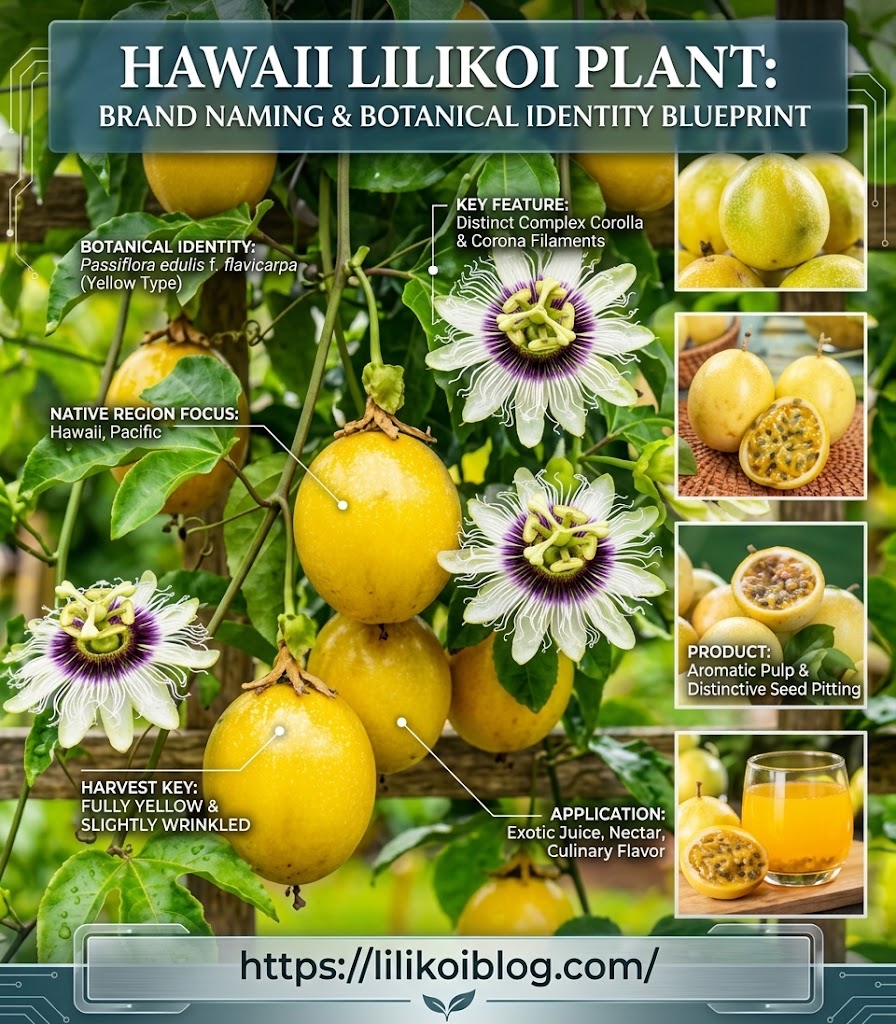
The Hawaii lilikoi plant (Passiflora edulis f. flavicarpa) is a fast-growing tropical passion fruit vine famed for its striking flowers and aromatic, tart yellow fruit. In strategic brand development, the plant symbolizes rapid scaling, vibrant energy, and high-value tropical positioning.
Most brand founders fail because they grab random tropical terms off generic naming generators without understanding cultural resonance or semantic structure. A name isn’t just a label on a website—it is your first piece of intellectual property and your core emotional hook.
When modern consumer brands tap into the iconic Hawaiian fruit lilikoi, they aren’t just selling a flavor or product. They are leveraging decades of consumer associations around paradise, artisan craftsmanship, and sun-drenched authenticity.
At Lilikoi, we turn botanical heritage into high-converting brand naming architecture. Let’s break down the naming psychology of the Hawaii lilikoi plant, examine categorized name formulas inspired by tropical flora, and equip you with a concrete framework to build your next venture.
Categorized Brand Names Inspired by Tropical Botanical & Island Vibes
Whether launching a consumer packaged goods (CPG) line, a wellness brand, or a boutique hospitality concept, here are curated name ideas leveraging the essence of the Hawaii lilikoi plant:
1. Modern & Premium Lifestyle
- Lilikoi Crest | Vibe: Elevated tropical luxury with crisp authority | Best For: Boutique resorts, premium skincare, artisanal spirits.
- Aurelia Vine | Vibe: Golden, botanical elegance and natural growth | Best For: Clean beauty lines, organic teas, luxury wellness.
- Flora Lilikoi | Vibe: Fresh, botanical, farm-to-table simplicity | Best For: Organic food CPG, cold-pressed juices, plant medicine.
2. Aesthetic & Island Coastal
- Pacific Lilikoi | Vibe: Ocean breezes, authentic island roots | Best For: Surf lifestyle apparel, island-inspired RTD beverages.
- Solstice Vine | Vibe: Sun-drenched energy and lush growth | Best For: Summer seasonal releases, outdoor recreation gear.
- Nectar Drift | Vibe: Effortless tropical relaxation | Best For: Functional soda, beachside hospitality, loungewear.
3. Minimalist & Clean
- Lili & Co. | Vibe: Modern, approachable, social-first | Best For: E-commerce brands, DTC lifestyle products.
- Flavicarpa | Vibe: Scientific, sleek, pharmaceutical-grade purity | Best For: Botanical supplements, high-performance skincare.
- Vine & Bloom | Vibe: Natural growth, organic scaling | Best For: Sustainability consultants, green tech ventures.
Linguistic & Naming Psychology Breakdown
Why does the phrase Hawaii lilikoi plant trigger such a immediate sensory response in naming research? It relies on three foundational linguistic blocks:
“`htmlRegional Authority + Vowel Fluidity & Soft Consonants + Botanical Anchor
A strong naming framework can combine regional identity, phonetic qualities, and a clear botanical association. In this structure, Hawaii provides the regional authority, Lilikoi contributes vowel fluidity and soft consonant movement, and Plant serves as the botanical anchor.
Regional Authority: Hawaii
Hawaii establishes a strong geographic and cultural association. As a regional reference, the word immediately suggests tropical landscapes, island agriculture, local flavors, and Hawaiian identity.
Vowel Fluidity & Soft Consonants: Lilikoi
Lilikoi has a flowing phonetic structure with repeated vowel sounds and relatively soft consonant transitions. This gives the word a smooth, rhythmic quality that can feel natural and memorable when used in a naming concept.
Botanical Anchor: Plant
Plant provides the botanical category. It gives the naming framework a direct connection to nature, cultivation, greenery, and the biological source associated with the name.
Hawaii + Lilikoi + Plant
The complete naming formula can be represented as:
Hawaii establishes the regional identity, Lilikoi creates the phonetic character, and Plant identifies the botanical category.
Understanding the Three-Part Structure
1. Hawaii — Regional Authority
The first component is Hawaii. A geographic name can add context to a product, concept, or brand by connecting it with a particular place and its associated environment.
In this framework, Hawaii acts as the authority layer. It establishes the regional setting before the audience encounters the botanical reference.
2. Lilikoi — Vowel Fluidity & Soft Consonants
The second component is Lilikoi. The word has a distinctive rhythm created by its repeated syllables and vowel sounds.
Lilikoi is also a Hawaiian-associated name for passionfruit. Botanical references identify Passiflora edulis as passion fruit and list lilikoi among its common Hawaiian-associated names.
3. Plant — Botanical Anchor
The final component is Plant. This word makes the botanical category explicit and creates a direct connection between the name and the natural world.
As a category term, plant can communicate ideas such as growth, cultivation, nature, agriculture, greenery, and botanical identity.
Complete Naming Formula
| Element | Example | Function |
|---|---|---|
| Regional Authority | Hawaii | Establishes geographic identity |
| Phonetic Descriptor | Lilikoi | Adds vowel fluidity and soft sound movement |
| Botanical Anchor | Plant | Creates a direct nature-based category |
| Complete Concept | Hawaii + Lilikoi + Plant | Combines regional, phonetic, and botanical meaning |
Why Lilikoi Works as the Middle Element
The middle element is important because it connects the geographic authority with the botanical category. Lilikoi performs that role by providing a recognizable Hawaiian-associated term while also contributing a distinctive sound pattern.
The word can therefore function on two levels: it provides linguistic character while also pointing toward a botanical and fruit-related concept.
Botanical Connection
Lilikoi is associated with passionfruit, and botanical references document Passiflora edulis in Hawaii. The plant belongs to the Passifloraceae family and is described as a climbing vine or liana.
This botanical connection gives the naming framework a concrete natural reference rather than leaving the name entirely abstract.
Regional Identity Meets Botanical Language
Combining a place name with a botanical term can create a strong conceptual structure. Hawaii establishes the setting, while Lilikoi introduces a regionally recognizable botanical association.
The final category, Plant, makes the natural-world connection immediately understandable.
At a Glance
- Hawaii → Regional Authority
- Lilikoi → Vowel Fluidity & Soft Consonants
- Plant → Botanical Anchor
The Full Concept
When the three elements are brought together, the framework becomes:
Hawaii
→
Regional Authority
Lilikoi
→
Vowel Fluidity & Soft Consonants
Plant
→
Botanical Anchor
Together, these components create a naming model that connects place, sound, and nature. The regional element establishes context, the phonetic element creates identity, and the botanical anchor provides a clear category.
Phonetic Fluidity: The word “Lilikoi” (lil-i-koi) relies heavily on liquid consonants (L) and open vowels (I, OI). Phonetically, soft liquid sounds evoke smoothness, liquid refreshment, and warmth. This prevents brand names from sounding harsh or clinical.
Sensory Anchoring: Mentioning the Hawaiian fruit lilikoi immediately triggers memory structures linked to tropical acidity, vibrant yellow hues, and summer vacations. Pre-loading sensory cues reduces customer acquisition costs because the brain processes familiar feelings instantly.
Growth Symbolism: A vine plant like the passion fruit grows rapidly, intertwines, and yields abundant fruit. For startups, embedding botanical growth entities into brand narrative signals vitality, resilience, and organic scaling.
Comparison & Brand Fit Matrix
| Brand Name Concept | Primary Meaning / Vibe | Ideal Industry / Category Fit | Target Audience |
| Hawaii Lilikoi Plant | Authentic botanical origin & island agriculture | Tropical AgTech, Educational Botanical Brands | Eco-conscious consumers, gardeners |
| Hawaiian Fruit Lilikoi | Tangy, exotic culinary authority | Gourmet food CPG, jams, craft beverages | Foodies, tropical flavor enthusiasts |
| Lilikoi House | Island hospitality & coastal relaxation | Boutique hotels, short-term rentals | Travelers, luxury vacationers |
| Golden Vine Co. | Abundant harvest & natural beauty | Clean skincare, botanical supplements | Gen Z / Millennial wellness buyers |
Common Pitfalls When Selecting Names
When building a brand around regional flora like the Hawaii lilikoi plant, avoid these common traps:
- Geographic Over-Cluttering: Stacking too many geographical modifiers (e.g., Hawaii Honolulu Lilikoi Co.) makes your domain long, clunky, and hard to type on mobile keyboards.
- Cultural Misappropriation: Ensure you respect Hawaiian culture and language. Use terms accurately and authentically rather than slapping indigenous words on unrelated products.
- Trademark Crowding: Always run trademark searches in your specific business class (e.g., Class 30 for food, Class 32 for drinks, Class 3 wrong for cosmetics) before locking down branding assets.
Strategic Selection Framework: Validating Your Name
Follow this 4-step framework to test any name inspired by the Hawaii lilikoi plant:
- The Radio Test: Say the name out loud over the phone. Can the other person spell it correctly without asking you to repeat it three times?
- The Visual Hierarchy Test: Drop the text into a simple logo mock-up. Does it look balanced as an app icon, packaging stamp, or favicon?
- The Search Engine Check: Type the prospective name into Google, ChatGPT, and Perplexity. Ensure you aren’t competing against an established industry giant for search engine share.
- The Expansion Test: Will this name still make sense if your brand expands beyond tropical products into broader categories 5 years down the line?
Frequently Asked Questions
What is the difference between passion fruit and the Hawaii lilikoi plant?
Lilikoi is the Hawaiian name for passion fruit. While purple passion fruit is common globally, the Hawaii lilikoi plant typically refers to the yellow variety (Passiflora edulis f. flavicarpa), known for its larger size, sharper acidity, and intense aroma.
Can I trademark a name containing “Lilikoi”?
Yes, provided the overall name combination is unique within your product class and does not cause consumer confusion with existing registered trademarks.
Why use tropical botanical terms for non-food brands?
Tropical terms evoke feelings of warmth, relaxation, natural purity, and escape. This makes them highly effective for skincare, apparel, travel, and wellness ventures.
The 1-Rule Golden Takeaway
A great botanical brand name pairs an exotic sensory hook with a grounded structure—keep it easy to pronounce, legally clear, and built for scaling.
