

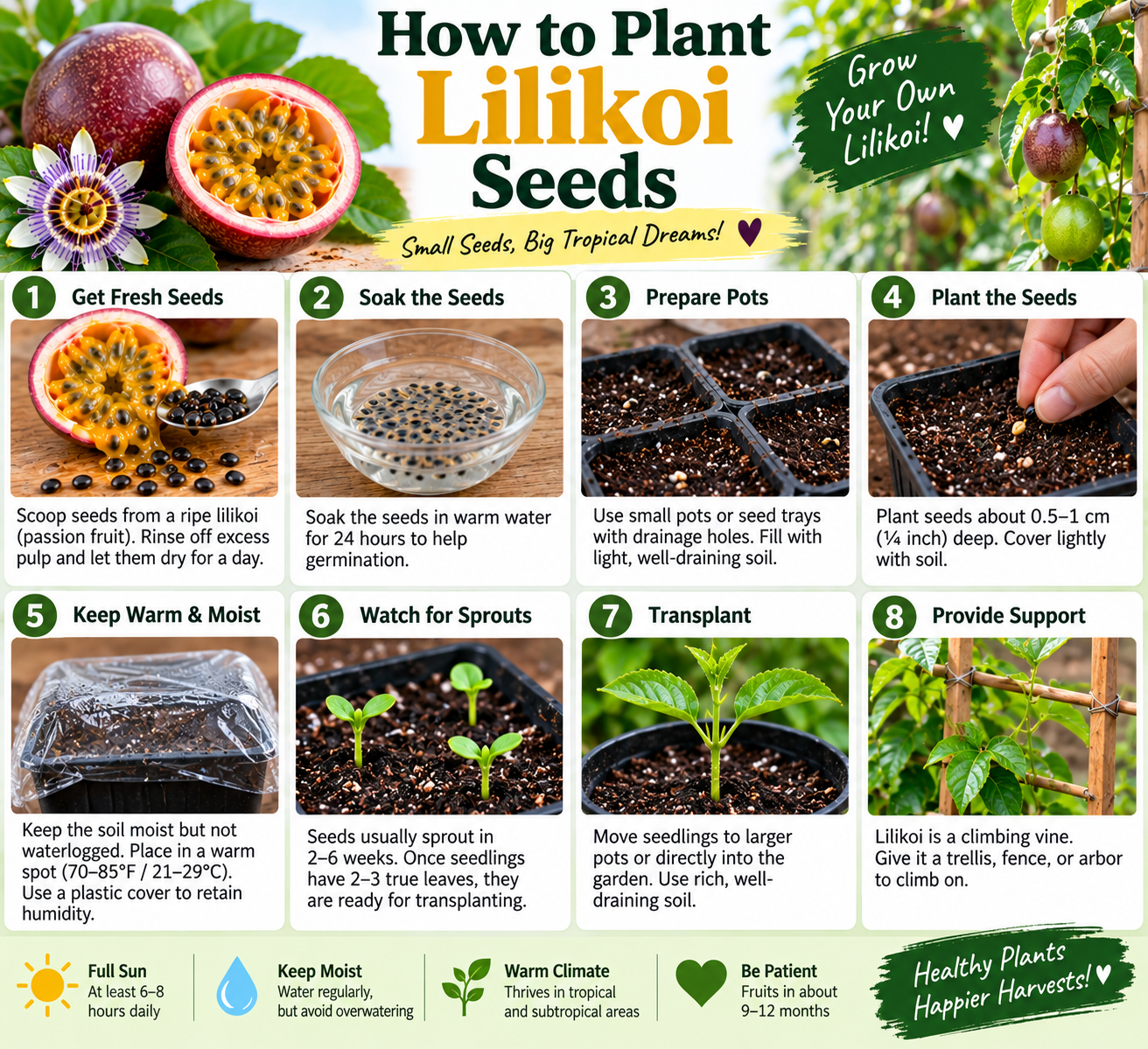
To learn how to plant lilikoi seeds, start by fermenting fresh passion fruit seeds in water for 24–48 hours to remove the gelatinous pulp, then sow them 1/2-inch deep in warm, well-draining potting soil kept consistently moist at 70°F–85°F (21°C–29°C). Germination typically takes two to four weeks under indirect sunlight.
Generic gardening guides often miss the crucial connection between seed prep and fruit production. Growing passion fruit isn’t just about burying a seed; knowing how to pollinate lilikoi once your vine blooms is the secret to converting flowers into heavy, purple-or-yellow fruit.
Here is how to take your lilikoi from seed to harvest without guessing.
Brand-Worthy Lilikoi Varieties to Grow
Before planting, match the seed variety to your local climate and garden setup.
- Yellow Lilikoi (Passiflora edulis f. flavicarpa) | Bold, tart, vigorous | Best for tropical regions, warm coastal zones, and massive trellises.
- Purple Passion Fruit (Passiflora edulis) | Sweet, aromatic, cold-hardy | Best for subtropical climates, container gardening, and smaller garden spaces.
- Panama Red Lilikoi | Exotic, sweet-tart hybrid | Best for warm microclimates and high-yield edible landscaping.
- Sweet Granadilla (Passiflora ligularis) | Mild, candy-like sweetness | Best for cooler subtropical valleys with frost-free winters.
Step-by-Step: How to Plant Lilikoi Seeds (H2)
Lilikoi seeds carry a natural dormancy mechanism inside their tough outer coats. Skipping proper seed preparation will lead to low germination rates or delay sprouts for months.
- Extract and Ferment: Scoop seeds out of a ripe fruit. Place them in a glass jar with a small amount of water for two days to break down the aril (pulp). Rinse thoroughly in a fine-mesh strainer.
- Scarify (Optional): Lightly rub dry seeds between two sheets of fine-grit sandpaper. This creates micro-abrasions that allow moisture to penetrate the seed coat faster.
- Prepare the Medium: Use a sterile, well-draining seed-starting mix (50% peat moss or coconut coir and 50% perlite). Avoid heavy garden soil, which traps excess water and causes seed rot.
- Sow the Seeds: Plant seeds 1/2-inch deep in individual seed trays or small pots. Gently press the soil down and water thoroughly with a spray bottle.
- Maintain Heat and Humidity: Cover the tray with a clear plastic humidity dome. Place it on a heat mat set between 75°F and 85°F in bright, indirect light.
Pro Tip: Fresh seeds germinate in 14–21 days. Older, dried store-bought seeds can take anywhere from 30 to 90 days to break dormancy.
How to Pollinate Lilikoi for Maximum Yield (H2)
Growing a lush, green vine is easy—getting it to produce fruit requires understanding how to pollinate lilikoi effectively. While purple varieties are often self-fertile, yellow lilikoi vines require cross-pollination from a genetically distinct lilikoi vine to set fruit.
- Identify the Bloom Time: Lilikoi flowers open for just one day, usually in the early morning for purple varieties and mid-afternoon for yellow varieties.
- Collect the Pollen: Locate the five yellow, pollen-covered anthers hanging beneath the central structure of the flower. Use a small artist’s paintbrush or a cotton swab to gently scrape off the yellow dust.
- Transfer to the Stigma: Transfer that pollen directly onto the three upward-curving stigmas located at the top center of the flower.
- Cross-Pollinate (Yellow Varieties): If you are growing yellow lilikoi, take pollen from a flower on Vine A and apply it to the stigma of a flower on Vine B.
If native carpenter bees or honeybees are scarce in your area, hand-pollination increases your fruit set success rate from under 20% to over 90%.
Lilikoi Planting & Pollination Quick-Reference Matrix (H2)
| Factor | Yellow Lilikoi (flavicarpa) | Purple Lilikoi (edulis) |
| Germination Temp | 75°F – 85°F (24°C – 29°C) | 70°F – 80°F (21°C – 27°C) |
| Time to Germinate | 14 – 30 Days | 20 – 40 Days |
| Pollination Type | Self-Incompatible (Needs 2nd vine) | Self-Fertile (Single vine works) |
| Best Pollinator | Carpenter Bees / Hand-Pollination | Honeybees / Self-Wind / Hand |
| Fruit Harvest Time | 60 – 80 Days after pollination | 70 – 90 Days after pollination |
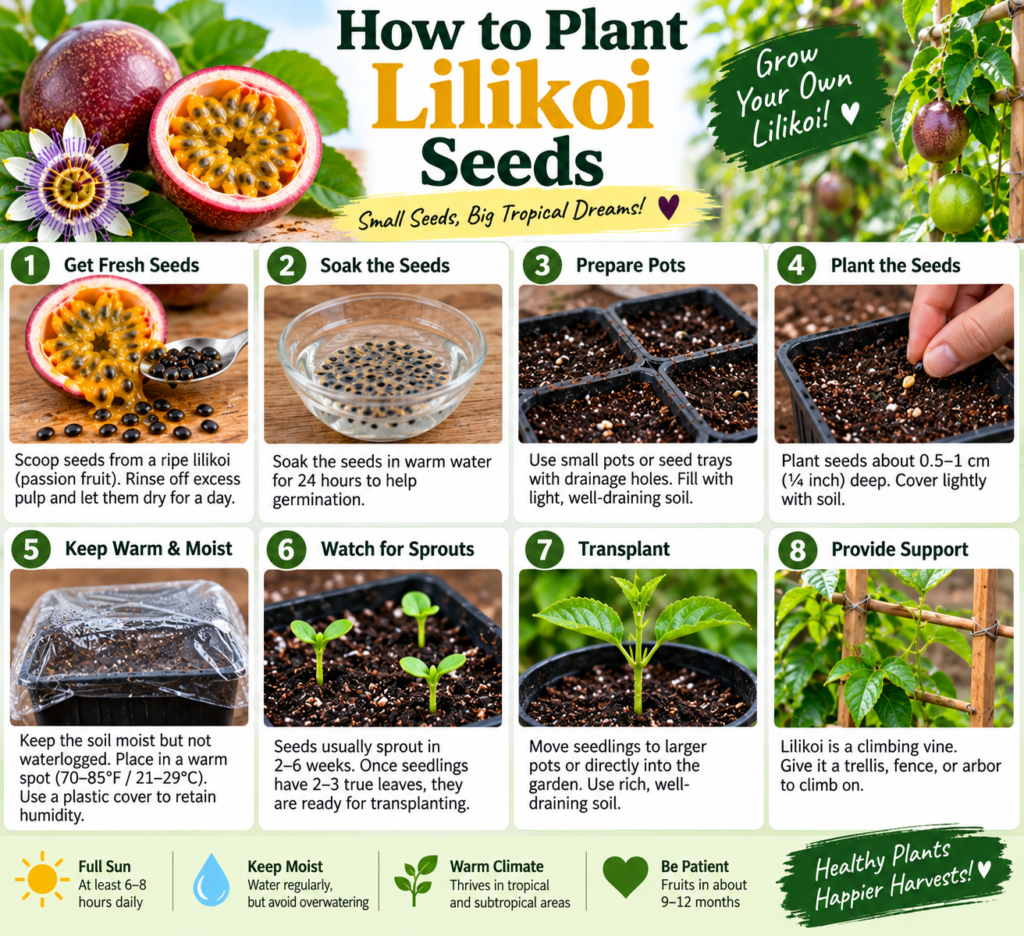
Common Pitfalls When Growing Lilikoi (H2)
- Overwatering Young Sprouts: Saturated soil starves roots of oxygen, leading to damping-off disease. Keep the medium moist, never soggy.
- Planting a Single Yellow Vine: Planting one yellow lilikoi vine results in hundreds of flowers but zero fruit due to self-incompatibility. Always plant two distinct vines.
- Excessive Nitrogen Fertilizer: High-nitrogen fertilizers create massive foliage and leaves, but suppress flower production. Switch to a high-potassium, high-phosphorus fertilizer once the vine reaches maturity.
- Shallow Trellising: Lilikoi vines are heavy and aggressive climbers. Weak trellises collapse under the weight of a mature vine bearing fruit. Build sturdy posts with heavy-gauge wire.
Strategic Growth Framework: Seed to Harvest (H2)
- Phase 1: Seedling Stage (Weeks 1–6)Keep seeds under humidity domes. Once two true leaves appear, transplant individual seedlings into 1-gallon pots.
- Phase 2: Vine Establishment (Months 2–5)Plant out into full sun (at least 6–8 hours daily). Install a sturdy fence or wire trellis. Prune lower side shoots to encourage a strong main leader trunk.
- Phase 3: Flower & Pollination (Months 6–9)Monitor daily for afternoon blooms. Practice hand-pollination daily during peak flowering cycles to maximize yield.
- Phase 4: Harvest (Months 9–12)Do not pick fruit directly off the vine while green. Allow lilikoi to drop naturally to the ground when fully colored and slightly wrinkled for peak flavor.
Frequently Asked Questions (H2)
Do I need two lilikoi vines to get fruit?
If you are growing yellow lilikoi, yes. Yellow varieties are self-sterile and require cross-pollination from a separate, non-identical lilikoi plant. Purple lilikoi vines are self-fertile and can produce fruit alone.
How long does it take for lilikoi to produce fruit from seed?
Under optimal warm conditions, a lilikoi vine grown from seed will begin flowering and bearing fruit in 9 to 12 months.
Why are my lilikoi flowers falling off without fruiting?
Unpollinated flowers fall off within 24–48 hours. This happens if pollinating insects are absent, weather is too hot (above 95°F/35°C), or you lack a second cross-compatible vine for yellow lilikoi.
The 1-Rule Golden Takeaway (H2)
Healthy lilikoi fruit production requires both patience during seed germination and proactive action during pollination. Seed preparation gets your vine out of the ground, but active hand-pollination ensures your vine actually rewards you with fruit.
